The Power of Play: Fostering Innovation Through Student Exploration at Pine Crest Lower School
"Play is our brain’s favorite way of learning."— Diane Ackerman
At Pine Crest School, purposeful learning is not limited to traditional approaches; it draws upon one of the most powerful and enduring forces in child development: play. Dr. Kristin Shealy, Fort Lauderdale Head of Lower School and Assistant Head of Campus, emphasizes, “Play is not something separate from learning or a break from learning; it is learning. When children play, they develop skills and engage their brains in ways that help build and strengthen connections for future learning.” This is supported by research from the National Institute for Play, which shows that play is fundamental to creativity, problem-solving and resilience. When children play, they are not simply having fun; they are testing ideas, building confidence and training their minds to adapt to new situations. At Pine Crest, this philosophy underpins every opportunity students have to explore, tinker and innovate.
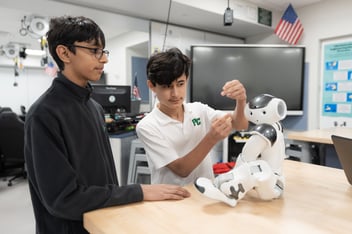
In the Lower School, students engage in open-ended exploration with a variety of tools and inquiry-based experiences. Students choose from available resources and experiment beyond their intended purpose. This freedom promotes creativity and problem-solving as students discover new applications for familiar technologies. Boca Raton campus Lower School Head, Jason Foreman, shares, “Play is more than an activity; it is a mindset that fuels curiosity and creates opportunities for learning across academics and social development.”
Mihaly Csikszentmihalyi's work on Flow Theory explains why students often lose themselves in these activities. When they are deeply immersed in exploration, they enter a state of flow where curiosity, persistence and joy intersect. Similarly, research from the National Institute for Play demonstrates that tinkering helps children rehearse innovation through trial-and-error experimentation in safe yet challenging contexts.
Structured Freedom: Balancing Independence and Guidance
While oftentimes play is designed to be open-ended, exploration time is not completely unstructured. Students understand that there are expectations for active engagement and responsible use of resources. This approach mirrors the research of Kathryn Hirsh-Pasek and Roberta Golinkoff on guided play, which emphasizes that play is most effective when it is scaffolded with subtle guidance. In this setting, children have the autonomy to experiment, while teachers serve as mentors, providing boundaries, encouragement and occasional direction.
The environment functions much like exploring a library. Students may not read every book, but browsing itself leads to discovery, insight and inspiration. This balance of support and independence is central to developing creative confidence. Dr Shealy witnesses the power of play and shares, “As children play, they discover themselves, their interests and their strengths as well as practice regulating their emotions and navigating their social worlds.”
Considerations for Effective Exploration
To maximize the benefits of playful exploration, Pine Crest aligns its practices with key findings from research on play and innovation that focus on both age and stages of development:
- Independence: Students explore age-appropriate tools that support autonomy while building competence.
- Size and Space: Flexible spaces allow tools to be used collaboratively and safely.
- Safety: Tools such as Osmo, Ozobots, LEGO® Robotics and Dash Robots are chosen because they balance safe use with opportunities for exploration.
- Clear Expectations: Families and teachers are encouraged to view these sessions as purposeful opportunities for discovery rather than assignments with specific outcomes.
This approach reflects findings from the Maker Education Initiative, which highlights that open-ended tinkering cultivates STEM skills, creativity and perseverance.
Incorporating Exploration and Play in Schools
Schools can bring exploration and play into their learning environments in several creative ways:
- Before and After School Hours: Extending time for imaginative problem-solving.
- Recess Programs: Offering maker activities or library access alongside outdoor play.
- Genius Hour or Maker Tables in Classrooms: Providing tools like Snap Circuits for unstructured building and experimentation.
Mitchel Resnick’s research at the MIT Media Lab Lifelong Kindergarten group asserts that playful experiences of imagining, creating and sharing are essential in nurturing innovators who thrive in a changing world.
The Benefits of Student Exploration and Play
Jason Foreman highlights, “When students have the freedom to explore materials, test ideas and follow their interests, they engage in the kind of discovery that strengthens problem-solving skills, builds resilience and sparks creativity.” Offering choice and freedom highlights the strengths of both high achievers and those who may thrive in less traditional settings. Research on the Maker Education Initiative and Universal Design for Learning demonstrates that multiple entry points for exploration promote equitable learning and engagement.
The power of play is transformative. By weaving play into purposeful learning, Pine Crest School helps students build the creativity, confidence and adaptability they will need to cultivate a growth mindset and grow into confident problem-solvers. Dr. Shealy reminds us that, “Most importantly, play teaches children that learning is fun and engaging. At home and at school, play is a child’s first and best teacher.”