Teaching Students to Disagree Well
Pine Crest's partnership with Dialogue Vanderbilt, an initiative dedicated to open dialogue and civil discourse in education, took root when President Dr. Dana Markham '18H and Vice President of College and Academic Advising Mrs. Marcia Hunt '12H sat down with Vanderbilt University's leadership team to discuss the critical issue of discourse on college campuses. That conversation grew into something larger: Pine Crest became Vanderbilt's exclusive independent school partner for a summit on open dialogue and civil discourse, bringing heads of school, faculty and students from across the country to Nashville to wrestle with a single question. How do we teach young people to sit with disagreement instead of fleeing from it?
In fall 2025, Pine Crest sent a small delegation to the summit, including Assistant Head of Upper School and Dean of Student Services Mrs. Jamie Blosser Morris '02, Upper School English Department Chair Dr. Tom Lolis '94 and Upper School Social Science Department Chair Mrs. Stacy Nisman. What they found there confirmed something Pine Crest had already begun building at home.
Starting Where Everyone Starts
English I Honors is the one course every ninth grader at Pine Crest takes, which made it the natural place to introduce habits we hope students carry for four years and beyond. Dr. Lolis, working alongside Mrs. Morris and Mrs. Nisman, has spent the past year reshaping the course's first quarter into an interdisciplinary reader: poetry, essays and texts from science, history and philosophy, chosen not to survey a canon but to surface a question. How do disciplines that seem to speak different languages actually talk to each other?
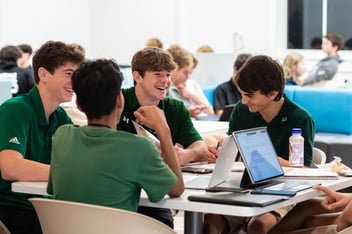
The redesign leans on two practices. The first, Harkness discussion, asks teachers to step back and let students drive the conversation. The second, drawn directly from Dialogue Vanderbilt faculty, is called From Every Angle. Students address a moderator rather than each other, which, as Mrs. Nisman describes it, "takes a lot of the 'I' out of it" and gives quieter students room to be heard without the pressure of confrontation.
The goal isn't winning an argument. It's building the tolerance for not having a tidy resolution, what Dr. Lolis calls learning to "be uncomfortable with not knowing the right answer."
Expanding Influence
In March 2026, Pine Crest and Vanderbilt hosted a full-day workshop for any interested educators to learn and observe these protocols in action. Faculty members from all Divisions and Disciplines joined in the workshops and conversations and watched how the protocols helped transform the classroom.
Working with Vanderbilt’s Open Dialogue team allowed Pine Crest educators to deepen their efforts to teach students to express their perspectives with empathy and understanding while engaging respectfully with a wide range of viewpoints. Although the strategies were designed for Upper School, members of the Middle and Lower School teams were invited to learn and adapt the strategies to strengthen the work they are already doing to build respectful and empathetic communities.
Why This Matters Beyond One Classroom
As AI takes over more of the work of producing and synthesizing information, the capacity to sit with another person's differing view, stay curious and respond thoughtfully looks less like a soft skill and more like the whole point of an education. Mrs. Morris, who approaches this work from her background as a counselor, points to something schools don't always name directly: many capable students learn to self-silence rather than risk friction, quietly narrowing their sense of self to avoid disagreement. Teaching dialogue as a skill, not an occasional unit but a practiced habit, is one way to interrupt that pattern.