In November 2022, ChatGPT, the generative artificial intelligence (AI) chatbot developed by OpenAI, went live. Some schools panicked. Some banned it outright. Others waited, hoping the technology would recede like other digital trends that had promised to transform education and then quietly hadn't. Pine Crest chose a different path. Within weeks of ChatGPT's release, Pine Crest convened a cross-divisional think tank of faculty to wrestle with a forward-looking question. How do we empower students to harness this technology ethically, creatively and with purpose?
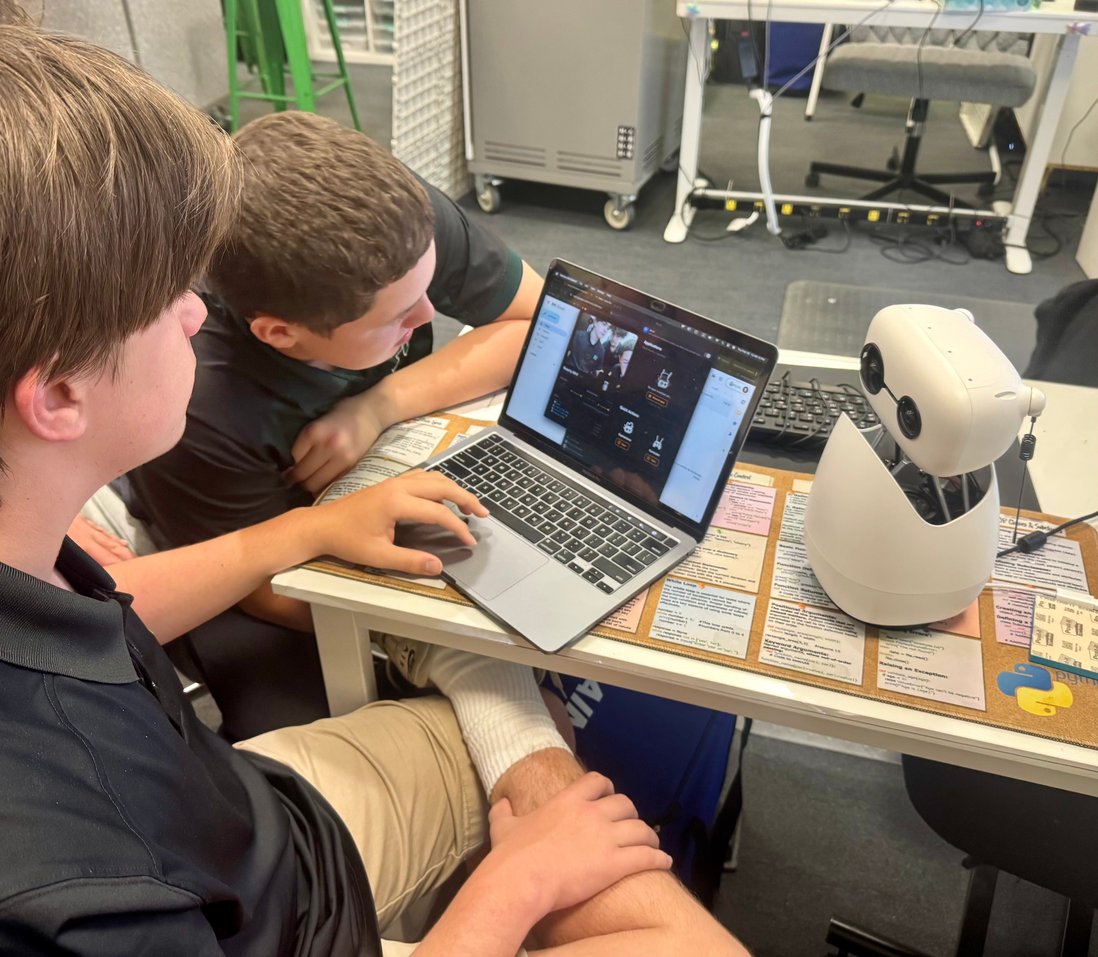
Middle School students investigate how small language models interact in an open-source robot.
That deliberate shift, from reaction to intention, has become the driving philosophy behind Pine Crest's approach to AI. It reflects a belief that education's role is not to shield students from the future, but to prepare them to shape it. For Dr. Lisa Ockerman, Vice President of Academic and Strategic Initiatives, hesitation was never an option in the face of a technology evolving at unprecedented speed. "AI is not a tool for tomorrow," she said. "It is truly a tool for today. It is our responsibility as educators to teach students how to use it ethically, with integrity, and how to be AI creators, not simply its users."
Teaching students how to use AI did not begin in 2022. Pine Crest's engagement with AI stretches back nearly a decade, rooted in a question the curriculum has been asking since long before “generative AI” entered popular vocabulary: what does it mean to prepare students for a world that does not yet exist? The computer science curriculum launched in 2015 with a foundational emphasis on machine learning and autonomous robotics. A post-AP AI course followed in 2017. By the time ChatGPT was introduced, Pine Crest had already built the scaffolding, conceptually, pedagogically and institutionally to engage with the technology. That history matters because it shapes how the school approaches each new development: as the next chapter in a curriculum designed to evolve, rather than as a disruption to manage. "Some schools were really nervous and hoped it would just go away," Dr. Ockerman said. "We knew it wasn't going away. We knew it was just going to keep progressing. Our students are going to go into a world where AI is a predominant element, even more advanced than what it is now."
The most overlooked dimension of AI in education is not the student. It is the teacher. A 2024 EdWeek Research Center survey of more than 1,100 educators found that only 43% had received a single training session on AI, demonstrating that the majority were navigating it entirely on their own, absorbing the technology unevenly and carrying that uncertainty into classrooms where students were arriving with questions their teachers had not yet been equipped to answer.
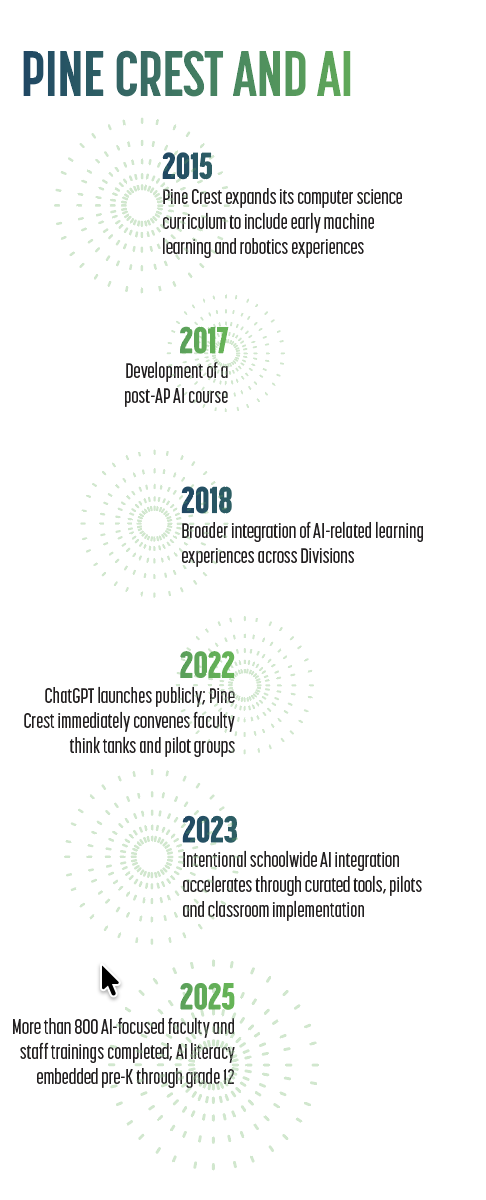
Under the leadership of President Dr. Dana Markham ’18H, the school committed to making faculty development the first priority, offering more than 800 training sessions this year alone to faculty and staff across all divisions. That commitment is further underscored by something rare in K-12 education: Pine Crest has a faculty member whose sole focus is AI, supporting teachers and students. The approach is deliberately graduated. Some teachers are already modeling AI fluency in their classrooms regularly. Others see the value for their own workload but are moving more cautiously with students. As technology evolves at such a remarkable pace, we have an incredible opportunity to empower teachers with the tools they need to lead students with confidence,” Dr. Ockerman said. “At Pine Crest, 100% of our faculty and staff have engaged in robust training in AI, an investment in our educators that truly sets our community apart. That is something Pine Crest practices that not many other schools do." She emphasizes that the goal is partnership, not replacement: “Great teaching remains at the heart of everything we do. AI simply enhances that work as a powerful support.” The most immediate application has been freeing teachers from the administrative weight that competes with the relational work at the heart of the profession. If AI handles lesson differentiation, assessment design and routine documentation, teachers reclaim time for personalized, one-on-one engagement with students, which is what matters most.
The school's approach to student-facing tools reflects the same philosophy of intention. Pine Crest maintains what Dr. Ockerman describes as a curated AI tool portfolio, spanning pre-kindergarten through grade 12, in which every platform has been evaluated not only for functionality but for what it demands of the learner. The central question is not efficiency but cognition: does this tool deepen thinking, or does it replace it? Snorkl, introduced as early as fourth grade, exemplifies the standard as an AI-powered educational tool. When a student submits an essay, it does not return a revised draft. It returns questions, a chain of prompts designed to push the student further into their own reasoning. NotebookLM, an AI research and note-taking assistant, serves a different function, particularly in Middle and Upper School, where students upload notes and readings and ask the tool to synthesize them into podcasts or concise study formats. The cognitive work of selection and curation remains the student's. For teachers, platforms like Curipod and Brisk Teaching are designed specifically to reduce administrative load, restoring time for the parts of the profession that no algorithm can perform. The through line across every tool in the portfolio is the same: AI as a thought partner, not a shortcut.
Long before Upper School students are debating the ethics of AI-generated content, students in pre-kindergarten are learning something more foundational: that AI is built by humans, governed by patterns and subject to the same errors and biases as the people who built it. Pine Crest structures its pre-kindergarten through grade 12 curriculum around five big ideas: that computers perceive the world through sensors; that AI agents maintain models of the world and use them for reasoning; that computers learn from data provided by humans; that intelligent agents require continuous human input to function; and that AI applications carry consequences, positive and negative, for the societies they touch. By the time students encounter generative tools in Upper School, they have spent years understanding what is happening behind them, and that foundation changes the nature of the encounter entirely. "When students understand that AI is a tool built by humans, they feel empowered to control it," Dr. Ockerman said. "They understand that when YouTube or Netflix suggests a video, it's guessing based on patterns, not reading their minds." The curriculum also leans into what Dr. Ockerman calls the more demanding literacy: knowing when not to trust AI. A recent Pine Crest neXt Collabsite brought librarians onto campus to teach students in grades four through 12 how to use AI for research while understanding its failure modes: how to verify a citation the model may have invented, how to recognize a confident-sounding hallucination and how to remain the author of one's own inquiry. "We're teaching them about the biases AI can have, the hallucinations it can give you and how to verify information," she said. "That critical thinking, that synthesis, that's where the real learning lives."
At the heart of Pine Crest's approach to AI is a conviction that deep learning takes time. True understanding is rarely instantaneous, and some of the most meaningful learning occurs when students are asked to slow down, sit with uncertainty, refine their thinking and shape ideas before they are truly formed. Pine Crest embraces this intentional balance. Technology-free spaces, real-world problem-solving and human-centered dialogue exist alongside AI-integrated learning, reinforcing the belief that efficiency should never come at the expense of depth.
Through Pine Crest’s partnership with Vanderbilt University's Open Dialogue program, students are challenged to articulate and defend ideas both verbally and in written form at a level that cannot be replicated by even the most sophisticated prompt.
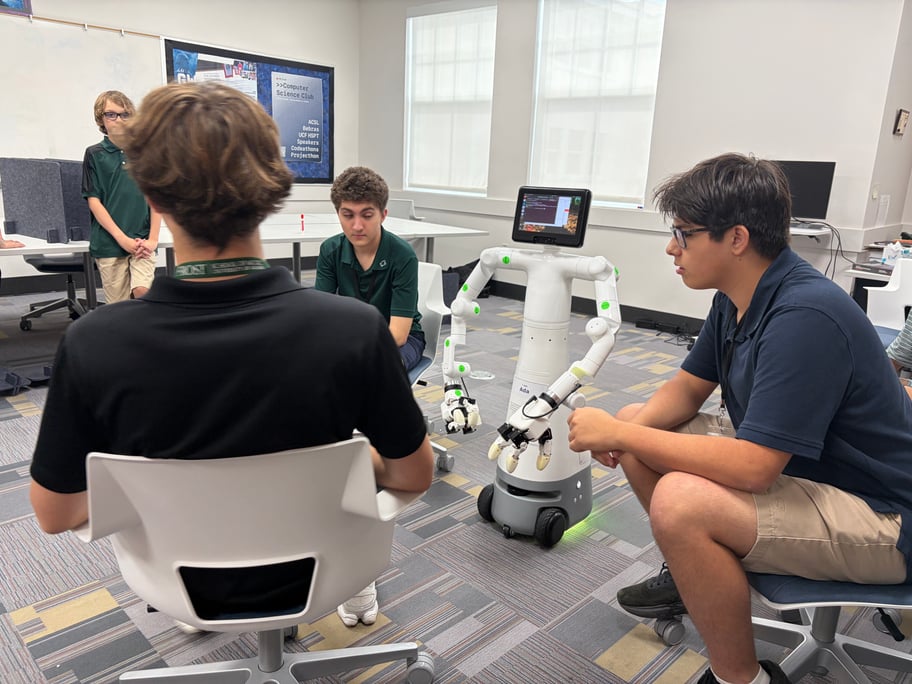 Upper School Post-AP AI students with a mercury robot they have synced with an LLM and have trained to be conversational
Data privacy is woven throughout the curriculum as well. Students developing ventures through the science research and social entrepreneurship programs, for example, are taught to distinguish between tools that feed data into larger AI systems and those with stronger privacy guardrails. “We take it seriously that students are working to solve real problems, and those problems deserve real protection,” Dr. Ockerman said. The school has extended this education to families as well, providing access to AI courses through Pine Crest neXt, scheduled after parent association meetings, so that parents can learn alongside their children rather than feel left behind.
When asked which human capacities matter more because of AI, Dr. Ockerman is clear: analytical and creative thinking, ethical judgment and contextual decision‑making, adaptability and resilience and the leadership and motivation to collaborate, to lead and to step forward, or aside, when the moment demands it.
What matters less, she argues, is rote recall. The capacity to retrieve facts on demand, once a meaningful proxy for learning, has been rendered less distinctive by tools that can surface any piece of information in seconds. What remains irreducibly human is the ability to evaluate, to connect, to persuade and to create with genuine intent. That is ultimately what Pine Crest is trying to protect.
The word Dr. Ockerman returns to most often is not "efficiency" or "innovation." It is "creator." "We want our students to be architects of the future," she said. "How can they use AI or any other technology to actually create the future? That's what this curriculum has been building toward for decades. “Our goal is to develop students who don’t just succeed, but lead—applying everything they learn to contribute thoughtfully and positively to the world.” The tools will keep changing. The pace will keep accelerating. But the goal, she says, is the same one Pine Crest has held for more than 90 years: to send students into the world capable of shaping it.
