There is a skill that no app can replicate, no artificial intelligence (AI) model can approximate and no standardized test has ever managed to measure. It is the ability to sit across from someone whose convictions are genuinely different from your own, to hear them out completely and to respond in a way that advances understanding rather than hardens division. It is, in a word, conversation.
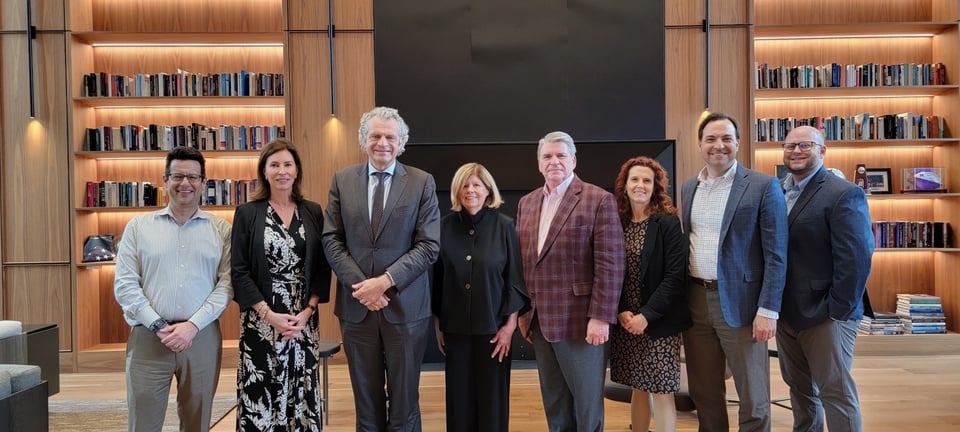 From left to right: Darren Reisberg, Vice Chancellor for Operations and the Campus Network; Dr. Dana Markham ’18H, President; Dr. Daniel Diermeier, Chancellor; Marcia Hunt ’18H, Vice President of College and Academic Advising; Doug Christiansen, Vice Provost for University Enrollment Affairs and Dean of Admissions and Financial Aid; Amy Huffman, Chief of Staff; Mike Drish, Executive Director of Undergraduate Admissions; John Palmer Rea, Associate Director of Admissions
Pine Crest School has partnered with Vanderbilt University on their Dialogue Vanderbilt initiative promoting open dialogue and civil discourse. It is a rethinking of something foundational: how students learn to think alongside people who do not think like them, and what it costs when they don't. The partnership began as a relationship built on mutual respect between two institutions that believe education carries a responsibility to the health of public life.
The timing is not incidental. As Dr. Lisa Ockerman, Vice President of Academics and Strategic Initiatives argued in these pages, AI is reshaping what it means to produce knowledge, and Pine Crest has met that challenge with intention and purpose. Open dialogue answers the question that follows: if AI can generate content, synthesize research and offload the cognitive tasks that once required sustained human effort, what remains irreducibly ours? The answer, it turns out, is the conversation: the ability to be present with another person, to stay curious when you're uncomfortable, to disagree without dissolving the relationship. These are the skills that will define leadership in the world that students are being prepared to enter.
The strong relationship between Pine Crest and Vanderbilt was exemplified when President Dr. Dana Markham ’18H, Dean of College and Academic Advising Mrs. Marcia Hunt ’12H and the Vanderbilt leadership team engaged in a discussion on the critical issue of discourse on college campuses. Reflecting a shared institutional character and vision, this collaboration resulted in Pine Crest becoming Vanderbilt's exclusive independent school partner for a summit on open dialogue and civil discourse. The summit brought together heads of school, faculty, students, and thought leaders from across the country to the Vanderbilt campus.
Mrs. Jamie Blosser Morris ’02, Assistant Head of Upper School and Dean of Student Services, Dr. Tom Lolis ’94, Upper School English Instructor and Mrs. Stacy Nisman, Upper School Social Science Instructor, were among Pine Crest's representatives at the summit. What they encountered in Nashville was a set of principles that the school was already reaching toward.
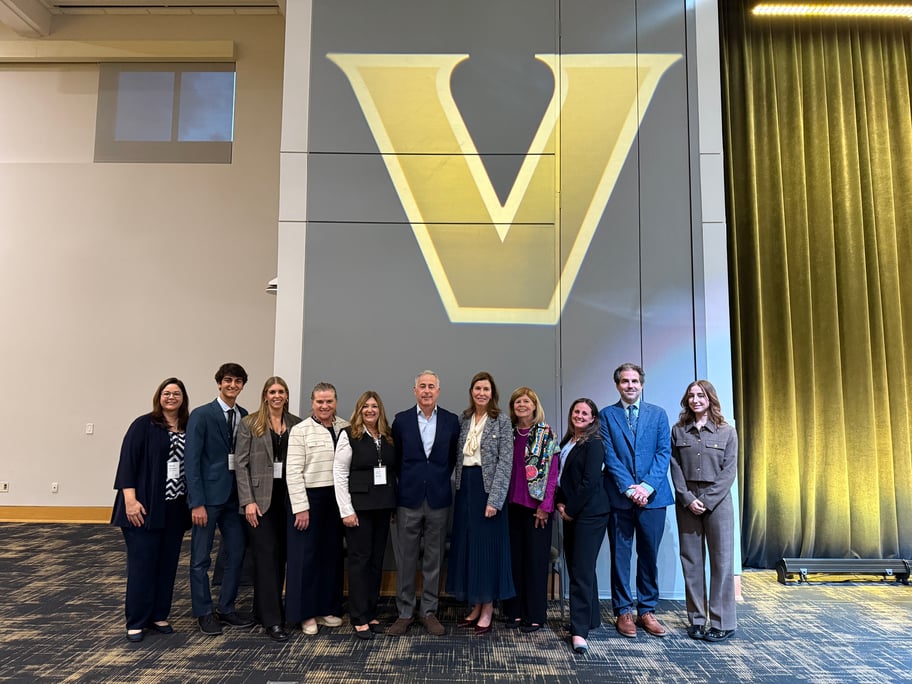 The Pine Crest School delegation at Vanderbilt University's Open Dialogue Summit in September 2025
“English I Honors is the only course that every ninth grader at Pine Crest takes,” said Dr. Lolis. That universality made it the ideal place to establish something the school wants every student to carry for four years and beyond.
Dr. Lolis led the curriculum redesign of English I Honors alongside Mrs. Morris and Mrs. Nisman. The first quarter of the course now functions as an interdisciplinary reader, drawing from poetry, essays and texts across science, history and philosophy, assembled not to survey a canon but to surface a question: how do disciplines that seem to speak different languages actually talk to each other, and what happens when they don't agree?
"The aim is to show students how these disciplines work together and talk to each other," Dr. Lolis said, "and to hook students who might not have a vested interest in novel X. We want to create some buy-in for both the work of the English classroom and the process of communicating well." More than that, the course asks students to do something genuinely difficult: to sit with the discomfort of not having a resolution. "How do we learn to be uncomfortable with not knowing the right answer? Our aim is not to have a debate every day where one side wins and one side loses. It's to have ongoing discussions where we all accept that we come at things from different viewpoints, backgrounds, and ideologies. And that's alright," he said.
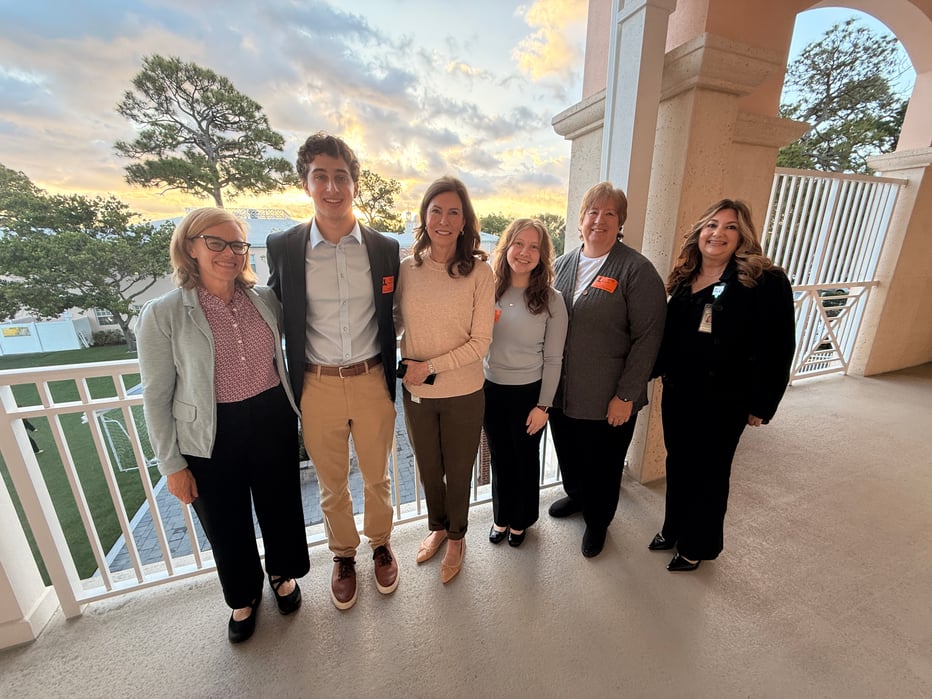
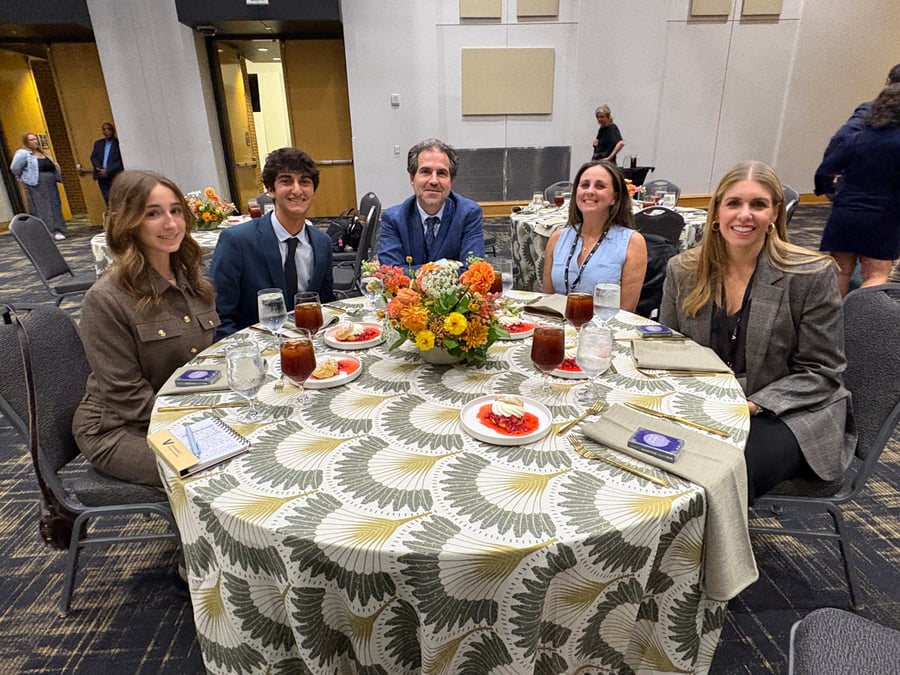 Veronika Hesse ’27, Isaac Pack ’27, Dr. Tom Lolis ’94, Mrs. Stacy Nisman and Mrs. Jamie Blosser Morris ’02 at the Open Dialogue Summit
The course introduces two specific practices that are designed to travel well beyond English I. The first is Harkness discussion, in which the teacher steps back and lets students drive the conversation, intervening only when the discussion drifts from inquiry toward contest. The second, drawn directly from Dialogue Vanderbilt faculty, is a method called From Every Angle.
From Every Angle works by removing the element that makes difficult conversations most difficult: the direct exchange. Students sit in a circle with a moderator at the center. A topic is introduced. One student addresses a perspective, directed not at any peer but at the moderator. When another student wants to respond or push back, they do not speak to the original speaker. They ask the moderator to pose the question on their behalf. The response comes back through the moderator as well. At no point do students in disagreement address each other directly.
The effect is disarming in the most literal sense. Mrs. Nisman described what it does for the students most likely to go unheard in a conventional discussion. "There are students who are much more naturally inclined to speak their mind, and they can be almost bulldozer-like," she said. "And so the ones who may have a difference of opinion might shrink into themselves. What From Every Angle does is take a lot of the 'I' out of it. A more reluctant student doesn't have to be in the center of the room, but they can still ask the questions and share their thoughts in a way that doesn't feel like a confrontation."
The method has been tested on topics that would ordinarily fracture a room. Charlie Siegel ’25, who graduated from Pine Crest last spring and now serves on the student advisory board for Dialogue Vanderbilt, has watched it work on some of the most charged subjects in American public life. "Directing your feelings away from the person and toward an indifferent chair diffuses a lot of the reactionary moments that you'd otherwise have," he said. "You can't really insult someone if you're not talking to them. I've seen it contribute to a much more calm environment, and by being calm, a much more meaningful conversation."
Mrs. Nisman added that the deeper gift of the method is not what it teaches students to do in the circle. It is what it teaches them to do in every conversation afterward. "Where there may not always be a moderator, there's always the ability to take a moment before you respond," she said. "That simple pause, especially where things are getting heated, diffuses tension."
 Dr. Dana Markham ’18H and Dr. Lisa Ockerman welcome Vanderbilt students and faculty, including Charlie Siegel ’25 to Pine Crest School
Mrs. Morris approaches this work from a unique vantage point as a counselor. "When we get down to what open dialogue is actually about,” she said, “it's about having a skill set to effectively communicate in the world and effectively relate to others in the world. Those are social and emotional skills. How do you assertively communicate a perspective while thinking about your tone, your timing and your audience? And then on the other side, being able to actively listen, to regulate your emotions when you hear something you disagree with. How do you stay open-minded and curious about what someone is telling you, rather than starting to formulate your reaction before they've finished speaking?"
One of the most important insights to emerge from the Vanderbilt summit, Mrs. Morris said, focused on what happens when students learn to suppress their perspectives instead of sharing them. Institutions found that many high-achieving students were self-silencing, reshaping what they said or believed to avoid social friction. As a result, some left their educational experience with a diminished, rather than expanded, sense of self.
“The question was: how do we prevent an entire class of amazing talent and perspectives from reaching the end of their experience having redefined their identity based on the opinion of a majority?” Mrs. Morris said. “When we create these opportunities in the classroom, how are we helping students develop as individuals and as a group by forming opinions and learning to articulate them thoughtfully?”
That question carries particular weight in a community as close as Pine Crest, where students often know each other across many years and the social cost of disagreement can feel more immediate than it might elsewhere. What Mrs. Morris observes in students who struggle with these conversations is rarely a deficit of ideas. It is more often anxiety: the fear of being wrong in front of people who will remember it, or the absorbed conviction, drawn from a digital landscape that rewards conflict and punishes nuance, that disagreement is inherently destructive. "We're moving toward automation and written communication, and the art of conversation is potentially getting lost or underpracticed," she said. "The relational skills are what continues to make humans valuable. That feeling of real heart-to-heart connection, of realizing that you share a perspective on something, that can't be replicated. That's the power of giving people intentional opportunities to have dialogue."
Redesigning English I Honors is not the destination. It is the point of entry. The skills introduced in the first quarter of ninth grade are intended to become a shared language across four years of Upper School, surfacing in AP social science discussions, in science classes where the data points to uncomfortable conclusions, in advisory periods and in the informal spaces where students actually negotiate their relationships with each other. "Pick a controversial topic in science,” said Mrs. Nisman. “Global warming, for example. You pick any topic where people might have polarizing viewpoints, and you're going to be practicing these skills."
The work is also moving through the Divisions deliberately. Middle School faculty have been part of ongoing planning conversations, and Lower School leaders have mapped where open dialogue principles already live in existing curricula, giving the Upper School a clearer picture of what students have already internalized when they arrive. The goal is not to introduce a new idea in ninth grade, but to name and deepen one that has been growing since the earliest years of a student's time at Pine Crest.
Charlie returned to Pine Crest's campus this past spring as part of a Vanderbilt delegation, leading workshops with students and sitting in conversations with faculty he had known as a student. He described the day as one of the most meaningful since his graduation. What struck him most was not the sophistication of the method or the ambition of the curriculum. It was the recognition that what Pine Crest had always been trying to build in students, the willingness to push past surface-level conversation, to stay present in a hard exchange, to remain curious rather than defensive, now had a name, a structure, and a growing movement behind it.
This summer he is traveling to Northern Ireland with Dialogue Vanderbilt to study the conflict resolution process that unfolded there over decades. He is going as someone who has tested these ideas in real rooms with real disagreement and found them to hold.
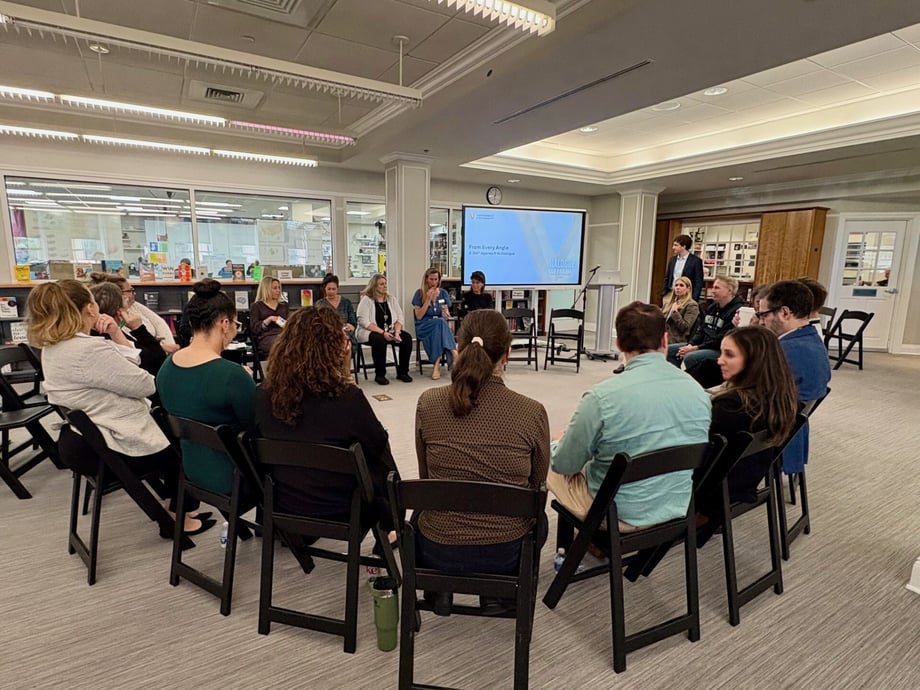 Charlie Siegel ’25 leads Pine Crest School faculty in From Every Angle dialogue method.
Ask him what has changed in him through this work, and he does not point to his ability to argue. He points to his capacity to listen. "I think it has built a stronger sense of empathy in me," he said. "I not only listen better and understand better, but I feel more deeply for people. The more conversations you have, the more nuance you build in how you understand people's situations, and the way they feel, and the way they would react." He paused before adding something that functions as both a conclusion and a beginning: "It becomes easier to have great conversations once you learn how to have great conversations. It's a skill I didn't know needed to be developed. And because I have it now, I just want to dive in more."
Mrs. Nisman sees disagreement as an essential part of growth, not something to avoid.
“Disagreement is not necessarily a bad thing,” she said. “Oftentimes, having a disagreement and having a discussion about it leads to new avenues you may not have thought of, new ideas, a new understanding of something you didn't have the experience to understand before. In life, it doesn't matter if someone is your best friend, your spouse, your sibling, your child. You're not always going to agree, and you need to learn how to have a healthy conversation around it. Even when you're mad. Especially when you're mad. Disagreement isn't an end. It's a means to something different, and possibly something better.”
In a world being reshaped by tools that generate language instantly, the ability to use it carefully has never mattered more.
